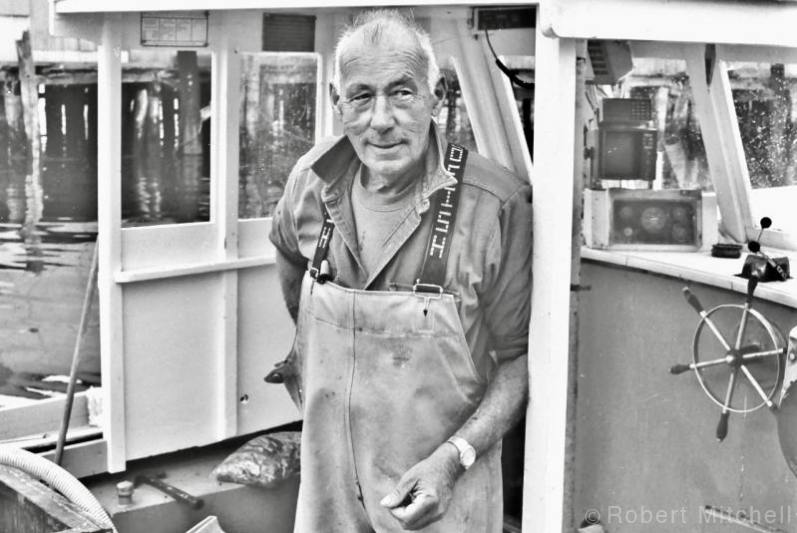
Recently, during a calendar delivery to Matt Parkhurst, we got to talking, as older friends are prone to do. I landed in the middle of Captain Parkhurst’s rebuilding of a substantial deck created for, among other things, the stacking and storing of firewood. The deck, as Matt suggested, would be built in the way one would expect a pier on the water might be built.
That is to say quite rugged and more likely to survive a big blow, high tide and a storm surge. I dare say, one might well be able to store a small bulldozer on the deck outside the kitchen door, which is highly unlikely, but you get the picture. There were big timbers awaiting placement and considerable massaccumulating!
During our chat, we got off track somewhat andinitiated some conversation about an old photograph I had made of Craig Sproul’s lobster boat, Cutter II, cruising across the Harbor amidst a significant gathering of sailing vessels during Windjammer Days of about 40 years ago. Matt liked the photo well enough to ask that I make a print for him, which I am happy to do. We reminisced about some of the “old timers” who Matt looked up to, many of whom I got to know as well. One such individual was Captain John Begin, aka “Old Horse.” Matt had some good stories to share and I was reminded of the time I photographed him with John for Charles Kuralt’s book “America.” Charles had interviewed John and several water-basedfolk like Bud Brackett, Gib Philbrick, Ken Brown and others. Not all the photos made it into the book but some of the conversations Charles had, did. One conversation with John Begin, regarding a serious experience he’d had during a severe storm offshore, was included. I’d like to share a portion of that conversation from the book.
John lost some good friends. At the time of the interview John was 72 and still lobstering. This would have been around 1994 when he chatted with Charles, just after John had checked himself out of the hospital after he’d had a little stroke. He left the hospital, partially because his doctor objected to John’s smoking a cigar in his hospital bed. He was back on his boat the next morning!
Directly from Charles’s book, the conversation is as follows. “It was in January,” John said, “40 years ago. We were two boats six miles off Monhegan, three of us on each boat. My friend Lou was skipper of our boat, the Sandra and Earl, and my friend Kit was skipper of the other boat. The wind came up, but we were out there to make money. Nobody came in just because of wind. We had a riding sail and we were riding OK. I was asleep below. I didn’t think anything special was happening.
“Well, the wind came up to 80 miles an hour. One big sea moved the house back and laid the boat on its side. The boat stayed on its side a good long time. I thought it might not come back up. We had no radio, of course, and we lost touch with the other boat. We thought they’dgone off and left us.Lou needed to keep her into the wind, so he broke the stove loose from the deck and used the stove for a sea anchor.
“This was a Tuesday, I think. A Coast Guard plane finally saw us on Friday, and they sent a boat out to tow us ... right into the harbor. It was late at night and I thought, well, we’ll have to call a cab to get home. But when we got closer, my God, everybody in town was down there to meet us. The floats were all underwater with the weight of the people. That’s when we found out that the other boat was lost. They never found one thing.”
John tolerated me long enough for a few photos, but not much longer. He wasn’t shy about speaking his mind.